













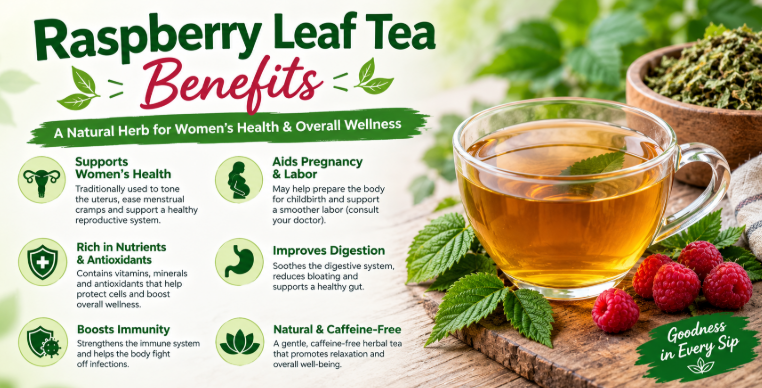
Raspberry leaf tea is a herbal drink made from the dried leaves of the red raspberry plant. It has a mild herbal taste and has been used in traditional herbal practices for many years. Today, people often search for raspberry leaf tea benefits because of its possible role in women’s health, especially during pregnancy.
The tea contains plant compounds such as polyphenols and tannins. However, traditional use does not always mean that a benefit has strong scientific proof. Research on raspberry leaf tea remains limited, so it is important to separate possible benefits from claims that have not been confirmed.
This guide explains the main raspberry leaf tea benefits, what research suggests, how people commonly use it, and when you should take care with it.
What Is Raspberry Leaf Tea?
Raspberry leaf tea comes from the leaves of the red raspberry plant, rather than from the fruit. The dried leaves are usually steeped in hot water to make an herbal infusion.
Unlike raspberry fruit tea, raspberry leaf tea does not mainly provide a sweet berry flavour. Its taste can be earthy, slightly bitter and similar to a mild black tea. You can drink it hot or chilled, depending on your preference.
The leaves contain several natural plant compounds. These include tannins, flavonoids and other polyphenols. These compounds help explain why raspberry leaves have attracted interest in traditional herbal use.
Raspberry Leaf Tea Benefits
It Provides Plant Compounds
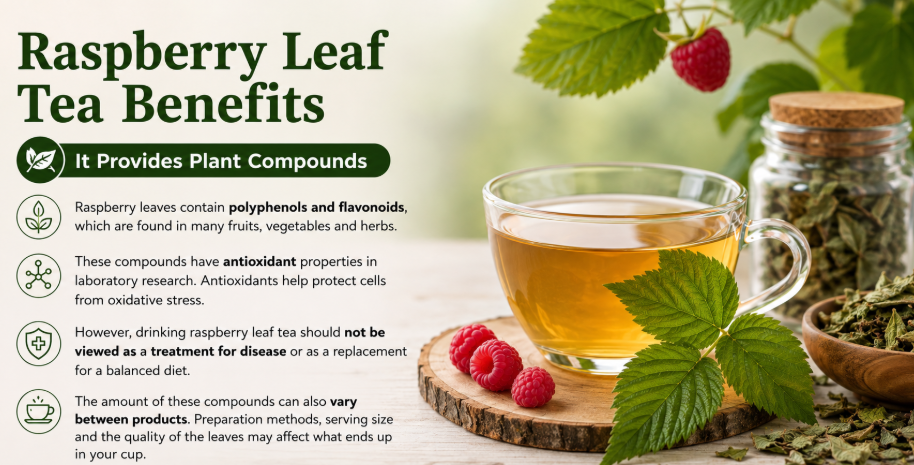
One possible benefit of raspberry leaf tea comes from its natural plant compounds. Raspberry leaves contain polyphenols and flavonoids, which are found in many fruits, vegetables and herbs.
These compounds have antioxidant properties in laboratory research. Antioxidants help protect cells from oxidative stress. However, drinking raspberry leaf tea should not be viewed as a treatment for disease or as a replacement for a balanced diet.
The amount of these compounds can also vary between products. Preparation methods, serving size and the quality of the leaves may affect what ends up in your cup.
It Can Be a Caffeine-Free Drink
Plain raspberry leaf tea is naturally caffeine-free. This makes it an option for people who want a warm drink without the caffeine found in traditional tea or coffee.
For many people, replacing some caffeinated drinks with caffeine-free herbal tea can be a simple way to reduce overall caffeine intake. Still, you should check the label because some commercial herbal blends contain other ingredients that may contain caffeine.
It May Support Traditional Women’s Health Uses
Raspberry leaf has a long history of traditional use for women’s health. Herbal practitioners have commonly associated it with menstrual and reproductive health.
Some of these traditional uses relate to the muscles of the uterus and digestive system. Raspberry leaf contains compounds that may affect smooth muscle in laboratory settings. However, laboratory findings do not prove that drinking the tea produces the same effect in humans.
For this reason, traditional use should not be confused with a clinically proven medical benefit.
Raspberry Leaf Tea and Pregnancy
Pregnancy is one of the main reasons people look for raspberry leaf tea benefits. Some pregnant women drink raspberry leaf tea during the later stages of pregnancy because it has traditionally been associated with preparing the body for labour.
The evidence, however, is limited. Studies have not clearly shown that raspberry leaf tea reliably starts labour, makes labour easier, or prevents complications.
Research has also explored whether raspberry leaf could affect the length of labour. Results have not provided strong enough evidence to confirm a clear benefit.
Does Raspberry Leaf Tea Induce Labour?
Raspberry leaf tea is often described online as a natural way to induce labour. That claim is stronger than the available evidence supports.
There is not enough good-quality research to say that raspberry leaf tea reliably triggers labour. It should therefore not be treated as a natural labour-induction method.
Pregnant women should also avoid assuming that a herbal product is automatically safe because it is natural. Pregnancy can change how the body responds to herbs and medicines.
If you are pregnant and considering raspberry leaf tea, speak with your midwife, doctor or maternity team first. This is especially important if you have pregnancy complications or have been advised to avoid certain herbal products.
When Do People Start Drinking Raspberry Leaf Tea?
There is no universally agreed time when everyone should start drinking raspberry leaf tea during pregnancy.
Some traditional practices recommend starting during the third trimester and gradually increasing the amount. However, these routines are not based on strong evidence that proves a particular starting week or dose is best.
Because pregnancy needs vary, it is better to follow advice from your maternity professional rather than relying on a standard online schedule.
If your healthcare professional says the tea is suitable for you, start with the amount they recommend and stop if you notice an unwanted reaction.
How to Make Raspberry Leaf Tea
Raspberry leaf tea is usually prepared in the same basic way as other herbal teas. Place the recommended amount of dried raspberry leaf or a tea bag in a cup. Add freshly boiled water and allow it to steep according to the product instructions.
You can drink it warm or allow it to cool for a refreshing iced drink. Avoid adding large amounts of sugar if you are trying to keep your drink simple.
Different products can vary in strength. Therefore, always follow the preparation instructions on the packaging instead of assuming that every raspberry leaf tea has the same concentration.
Raspberry Leaf Tea Side Effects
Raspberry leaf tea may not suit everyone. Some people can experience digestive discomfort, nausea or loose stools after drinking herbal products.
Pregnant women should take extra care because the safety of raspberry leaf during pregnancy has not been established as strongly as the safety of many conventional foods and medicines.
People who take regular medicines should also consider possible interactions. Herbal products can affect the body in ways that may matter when combined with certain medicines.
Stop drinking the tea if you develop an unusual reaction and seek appropriate medical advice if symptoms are severe or persistent.
Who Should Avoid Raspberry Leaf Tea?
There is no simple rule that applies to every person. Your health, medicines and reason for using the tea all matter.
People who are pregnant, breastfeeding, taking regular medication or managing a medical condition should ask a healthcare professional before using raspberry leaf tea regularly.
You should also check the ingredients if you buy a raspberry leaf blend. Some products contain several herbs, and those additional ingredients may have their own safety concerns.
How Much Raspberry Leaf Tea Can You Drink?
There is no single scientifically established amount that guarantees a benefit from raspberry leaf tea.
Commercial products can vary in strength, while homemade infusions can differ depending on how much leaf you use and how long you steep it. As a result, simply counting cups does not always tell you how much of the plant compounds you have consumed.
If you want to drink raspberry leaf tea regularly, follow the product instructions. During pregnancy, ask your midwife or doctor for individual advice rather than choosing a dose based on social media or anecdotal reports.
Is Raspberry Leaf Tea Worth Trying?
For most healthy adults, raspberry leaf tea can be a pleasant caffeine-free herbal drink. It also contains naturally occurring plant compounds that make it interesting from a nutritional perspective.
The situation is different when you are expecting a baby. The popular claims about raspberry leaf tea and labour are not supported by strong enough evidence to treat the tea as a proven labour aid.
The best approach is to enjoy raspberry leaf tea for what it is: a herbal drink with a history of traditional use and some promising biological properties, but with several health claims that still need better research.
Conclusion
The main raspberry leaf tea benefits include its caffeine-free nature and its supply of natural plant compounds such as polyphenols and flavonoids. It has also played a long-standing role in traditional women’s health practices.
However, scientific evidence remains limited, particularly for pregnancy and labour. Raspberry leaf tea has not been firmly proven to induce labour or make childbirth easier.
If you are pregnant, taking medication or managing a health condition, talk to a qualified healthcare professional before using it regularly. A cautious approach is especially important when evidence about an herbal product remains limited.
FAQs
What are the main raspberry leaf tea benefits?
Raspberry leaf tea provides naturally occurring plant compounds and offers a caffeine-free alternative to regular tea and coffee. It also has a long history of traditional use for women’s health. However, many claimed health benefits still lack strong human evidence.
Is raspberry leaf tea good during pregnancy?
Raspberry leaf tea is commonly used during late pregnancy, but its safety and benefits have not been established with strong evidence. If you are pregnant, discuss it with your midwife, doctor or maternity team before drinking it regularly.
Does raspberry leaf tea start labour?
There is not enough reliable evidence to confirm that raspberry leaf tea starts labour. Although it is traditionally associated with labour preparation, it should not be considered a proven method of inducing labour.
Can you drink raspberry leaf tea every day?
Some adults drink raspberry leaf tea regularly, but the ideal long-term amount has not been firmly established. Follow the instructions for your product and seek professional advice if you plan to drink it daily for an extended period.
Does raspberry leaf tea contain caffeine?
Plain raspberry leaf tea is naturally caffeine-free. However, some commercial blends combine raspberry leaf with other teas or herbs. Check the ingredients before buying a blended product.
Can raspberry leaf tea help with periods?
Raspberry leaf has a history of traditional use for menstrual health. Some people use it as a herbal drink around their period. However, strong clinical evidence for treating menstrual pain or other period problems remains limited.
For more updates visit: HEALTH BLOOM











Discussion about this post