



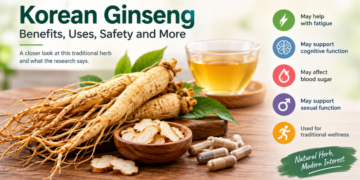







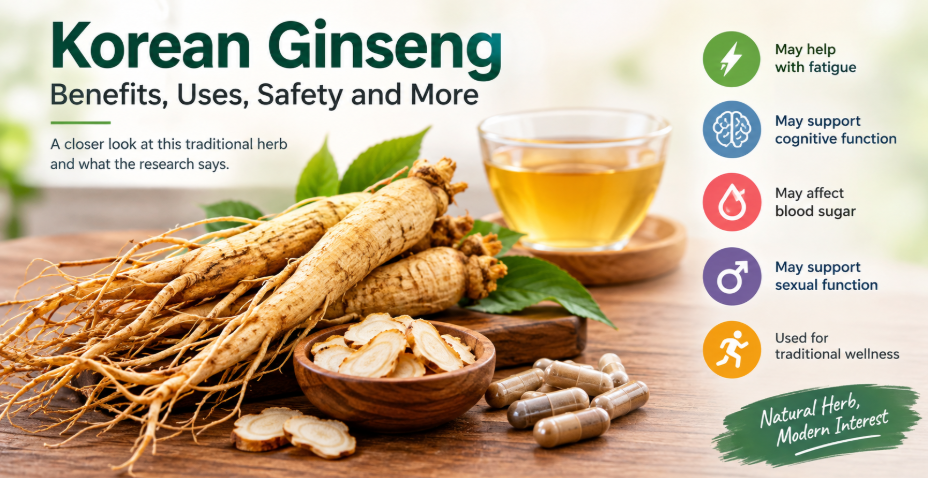
Korean ginseng is a popular herbal supplement. It comes from the root of Panax ginseng, also called Asian ginseng.
People have used this herb for centuries. Today, many people take it to support energy, focus and general health.
Research has looked at several possible health effects. Some results look promising. However, not every claim has strong scientific support.
This guide explains Korean ginseng, its possible benefits, common uses and safety concerns.
What Is Korean Ginseng?
Korean ginseng comes from the Panax ginseng plant. The root contains natural compounds called ginsenosides.
These compounds may affect several systems in the body. Researchers have studied them for their possible effects on energy, blood sugar, brain function and other areas.
You can find ginseng in many forms. These include capsules, powders, teas and liquid extracts.
The root also comes in different types. White ginseng and red ginseng are two common examples.
Korean Ginseng Benefits

Researchers have studied Korean ginseng for several health concerns. Results can vary between studies.
Some possible benefits have more support than others. Therefore, it helps to look at each one separately.
May Help With Tiredness
Fatigue is one of the most common reasons people use ginseng.
Some studies suggest that Asian ginseng may help reduce general tiredness. The effect may be small, though.
People with ongoing fatigue should not rely on ginseng alone. Tiredness can have many causes.
Poor sleep, stress, low iron and some health conditions can all cause fatigue. A healthcare professional can help find the cause when tiredness continues.
May Support Mental Performance
Korean ginseng has also attracted interest for brain health.
Some research suggests that it may help with certain areas of mental performance. These areas can include attention and thinking speed.
However, the research remains limited. Studies have also produced mixed results.
This means you should not view ginseng as a proven treatment for memory loss or other brain conditions.
May Affect Blood Sugar
Blood sugar is another area of interest.
Some studies have looked at whether ginseng can affect glucose levels. A few have found possible benefits.
However, results have not been consistent across all studies.
People with diabetes should take extra care. Ginseng may affect blood sugar levels. It may also interact with diabetes medicines.
Speak with a doctor or pharmacist before using it if you take diabetes medication.
May Support Sexual Health
Researchers have also studied Asian ginseng for sexual health.
Some studies suggest that it may improve certain aspects of erectile function. However, the evidence remains limited.
Erectile problems can have many causes. These can include diabetes, heart disease and other health conditions.
For that reason, persistent symptoms need proper medical advice. A supplement should not replace a medical check.
Korean Ginseng and Exercise
Many supplements market ginseng as a natural energy booster. Some products also claim that it can improve exercise performance.
Research does not strongly support these claims.
Studies have not shown clear benefits for athletic performance in most cases. Ginseng may still affect people in different ways.
Good sleep, regular exercise and a balanced diet remain important for energy and fitness.
Red Ginseng vs White Ginseng
Red and white ginseng both come from Panax ginseng. Their main difference comes from how manufacturers process the root.
White ginseng gets dried after harvest. Red ginseng goes through steaming before drying.
This process changes some of the natural compounds in the root. It can also affect the final product.
Neither type works best for everyone. The strength and quality of supplements can also vary.
Always check the product label. Look at the ingredients, extract strength and recommended serving.
How Do You Take Korean Ginseng?
Korean ginseng comes in several forms. You can find it as a tea, powder, capsule or extract.
The right amount depends on the product. Different supplements can contain different amounts of active compounds.
For this reason, there is no single dose that suits every product.
Follow the instructions on the product label. Do not take more than the recommended amount.
You should also remember that supplements do not replace a healthy diet. They should not replace treatment from a healthcare professional.
Korean Ginseng Side Effects
Most adults can use ginseng for short periods without serious problems. However, side effects can occur.
Sleep problems are among the more common side effects. Some people may also notice stomach upset or other digestive problems.
Taking large amounts may increase the chance of unwanted effects.
Rare reports have linked ginseng with serious allergic reactions and liver problems. It may also affect blood clotting and blood sugar.
Stop using a supplement and seek medical help if you develop a serious reaction.
Who Should Be Careful With Ginseng?
Some people should speak with a healthcare professional before using Korean ginseng.
This includes people who take regular medicines. Ginseng can interact with certain drugs.
People with diabetes should also ask for medical advice. Ginseng may affect blood sugar.
People with autoimmune conditions should take care too. Ginseng may affect immune activity.
Pregnant and breastfeeding women should also seek professional advice. There is not enough reliable evidence to confirm its safety in these situations.
What Does Research Say About Korean Ginseng?
Research into Korean ginseng continues to grow.
Scientists have studied its possible effects on fatigue, brain function, blood sugar and sexual health. Results vary between studies.
Some trials show potential benefits. Others show little or no clear effect.
Study size also matters. Some research has involved only a small number of people. Other studies have lasted for a short time.
Therefore, researchers still need more high-quality studies. Larger trials could provide a clearer picture of the possible benefits.
It is also important to separate traditional use from proven medical effects. A long history of use does not prove that a product can treat a specific condition.
How to Choose a Ginseng Supplement
Quality can vary between ginseng supplements.
Start by checking the label. Look for the plant name and the type of ginseng used.
You should also check the amount per serving. Some products contain extracts, while others contain powdered root.
Avoid assuming that a higher amount will provide better results. More is not always better.
If you take medicines or have a health condition, ask a pharmacist before choosing a supplement.
Conclusion
Korean ginseng comes from the root of Panax ginseng. It contains natural compounds called ginsenosides.
Research suggests that it may help with general fatigue. Some studies also show possible effects on mental and sexual health.
However, the evidence remains mixed. Researchers need more high-quality studies to confirm many of its proposed benefits.
Ginseng can also cause side effects and interact with some medicines. Therefore, use extra care if you have a health condition or take regular medication.
Used with the right information, Korean ginseng can be considered as part of a wider approach to health. It should not replace a balanced lifestyle or medical treatment.
FAQs
What is Korean ginseng?
Korean ginseng is a plant known as Panax ginseng. Its root has a long history of use in traditional Asian medicine.
Today, manufacturers use the root in teas, capsules, powders and extracts.
What are the main Korean ginseng benefits?
Possible benefits include support for energy and general fatigue. Research has also looked at mental performance, blood sugar and sexual health.
However, results vary. More research is needed to confirm many of these effects.
Is Korean ginseng the same as Asian ginseng?
Yes. Korean ginseng is a common name for Panax ginseng. Asian ginseng is another name for the same plant.
It differs from other plants called ginseng, such as American ginseng and Siberian ginseng.
Is red ginseng better than white ginseng?
Not necessarily. Both come from Panax ginseng, but manufacturers process them differently.
Red ginseng undergoes steaming before drying. White ginseng gets dried after harvest.
The best choice depends on the product and your individual needs.
Can Korean ginseng help with tiredness?
Some research suggests that ginseng may reduce general fatigue in certain people.
The effect may be modest. If tiredness lasts for a long time, speak with a healthcare professional to find the cause.
Does Korean ginseng improve memory?
Research has produced mixed results. Some studies suggest possible effects on certain areas of mental performance.
However, current evidence does not show that ginseng can treat memory disorders.
Can Korean ginseng affect blood sugar?
Yes, it may affect blood glucose levels. Research has found mixed results on its effect.
People with diabetes should speak with a doctor or pharmacist before using ginseng.
What are the side effects of Korean ginseng?
Sleep problems and stomach upset can occur. Some people may experience other unwanted effects.
Serious reactions are uncommon. However, seek medical help if you develop signs of a severe reaction.
Can I take Korean ginseng with medication?
Ginseng may interact with some medicines. The risk depends on the medicine and your health.
Ask a pharmacist or doctor before using it with prescription medication.
Is Korean ginseng safe during pregnancy?
There is not enough reliable evidence to confirm its safety during pregnancy.
Pregnant or breastfeeding women should speak with a healthcare professional before using Korean ginseng.
For more updates visit: HEALTH BLOOM










Discussion about this post