














Creatine is one of the most widely studied supplements for strength and exercise performance. Yet many people still wonder how much creatine per day they actually need.
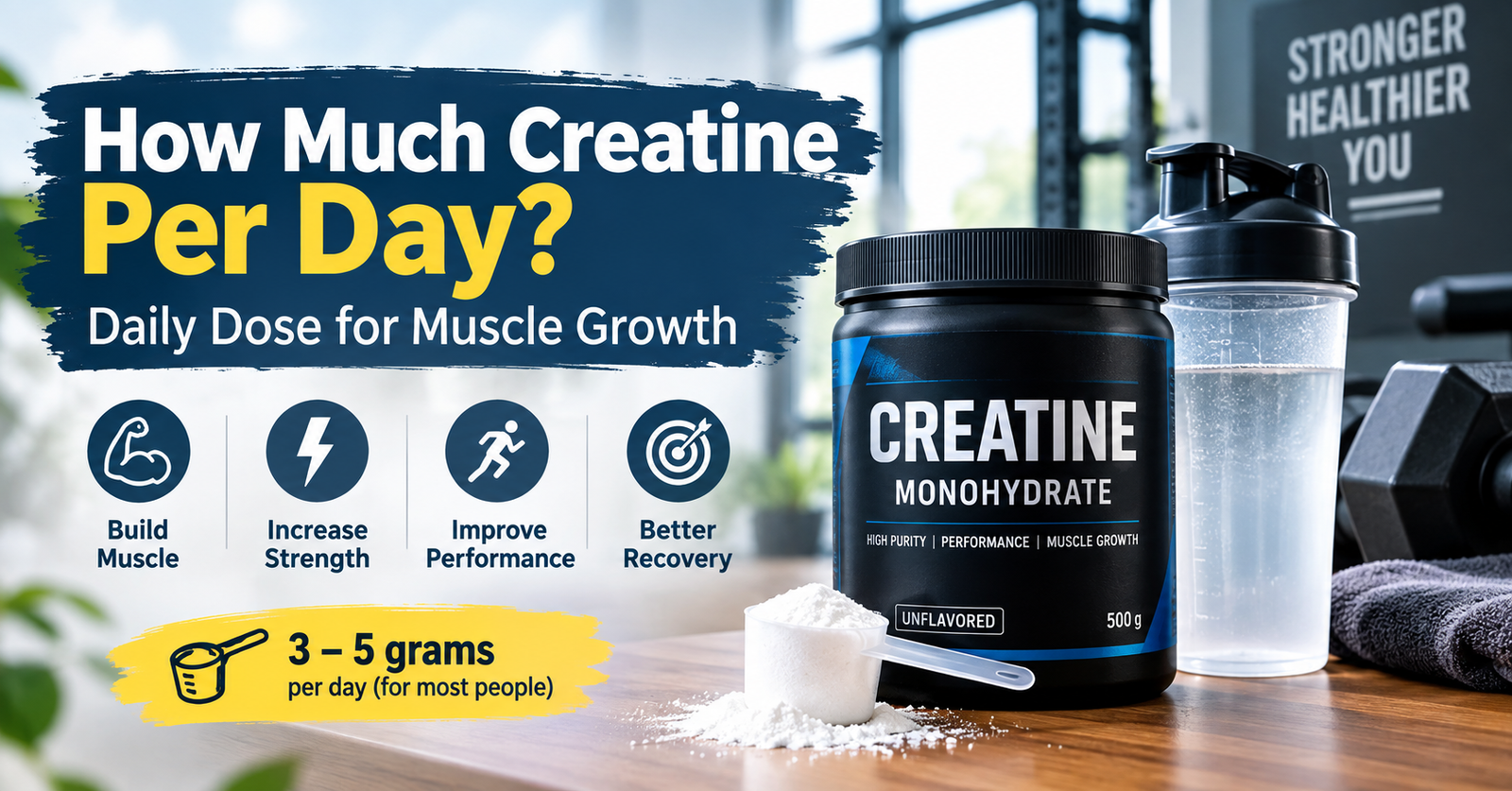
For most healthy adults, a daily dose of 3 to 5 grams of creatine monohydrate is commonly used. You do not need to take large amounts every day to maintain higher creatine stores in your muscles. Research also supports creatine monohydrate as the most extensively studied form of creatine supplementation.
If your main goal is muscle growth, consistency matters more than taking a very high dose. Creatine works by increasing the amount of stored creatine available to support repeated high-intensity activity.
How Much Creatine Per Day Should You Take?
For most adults, 3 to 5 grams of creatine monohydrate per day is a practical daily amount. A 5-gram serving is particularly common among people who use creatine for strength training and muscle growth. Research has used daily doses in this range to increase creatine availability in muscle tissue.
You can take your daily dose on training days and rest days. Creatine does not need to be taken only before or after exercise.
The key is regular use. Taking creatine consistently allows your muscle creatine stores to increase and remain elevated over time.
How Much Creatine Per Day to Build Muscle?
If you are asking how much creatine per day to build muscle, 3 to 5 grams is generally enough for most healthy adults.
Creatine does not build muscle by itself. Instead, it can support training performance by helping your muscles produce energy during short, intense efforts. Better training performance can contribute to improvements in strength and muscle size when combined with appropriate resistance training. Research has reported improvements in muscle mass and strength with creatine supplementation during resistance training.
Your overall programme still matters. Progressive resistance training, adequate protein, enough calories and good recovery all contribute to muscle growth.
Taking more creatine than needed does not automatically mean faster muscle growth.
Do You Need a Creatine Loading Phase?
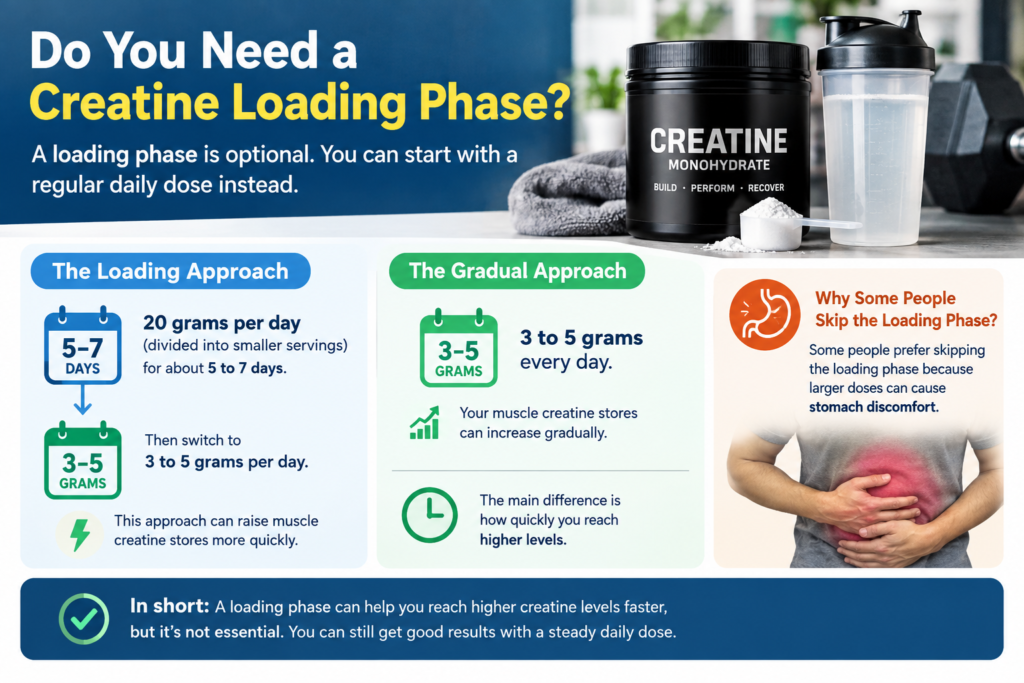
A loading phase is optional. You can start with a regular daily dose instead.
A commonly studied loading approach uses around 20 grams per day, divided into smaller servings, for about 5 to 7 days. After that period, people typically switch to around 3 to 5 grams per day. This approach can raise muscle creatine stores more quickly.
However, loading is not essential.
If you take 3 to 5 grams every day, your muscle creatine stores can increase gradually. The main difference is how quickly you reach higher levels.
Some people prefer skipping the loading phase because larger doses can cause stomach discomfort.
When Should You Take Creatine?
There is no need to take creatine at a specific minute of the day.
You can take it in the morning, before training, after training or with a meal. The most useful approach is choosing a time that helps you take it consistently.
For example, some people add creatine to a post-workout shake. Others take it with breakfast or another daily meal.
The important factor is regular daily intake rather than trying to find a perfect workout window.
Is 5 Grams of Creatine Per Day Enough?
Yes. For many adults, 5 grams per day is a straightforward daily dose.
You do not need to increase the amount simply because you have been using creatine for several months. A consistent maintenance dose can help maintain elevated muscle creatine stores after they have increased.
Individual needs can vary. Body size, diet, training status and previous creatine intake can influence how someone responds.
For that reason, there is no single dose that suits every person. However, 3 to 5 grams per day is a well-established practical range for healthy adults.
Should You Take Creatine on Rest Days?
Yes. If you use creatine daily, continue taking it on rest days.
Your muscles use and store creatine over time, so supplementation does not need to match your workout schedule. Skipping rest days is unnecessary if your goal is to maintain consistent intake.
For example, someone who trains four days a week can still take creatine on all seven days.
This approach also makes supplementation easier to remember.
What Type of Creatine Should You Use?
Creatine monohydrate is the most extensively studied form of creatine. Research has used it to investigate creatine stores, exercise performance, strength and muscle-related outcomes.
Many products promote alternative forms of creatine as being superior. However, the available research does not establish that these alternatives consistently outperform creatine monohydrate when equivalent amounts of creatine are compared.
A plain creatine monohydrate powder can therefore be a simple option for people who want to supplement.
Can Creatine Help You Build Muscle Faster?
Creatine can support muscle growth when combined with resistance training.
It may help you perform repeated high-intensity efforts during training. Over time, improved training capacity can contribute to greater strength and muscle development.
However, creatine is not a substitute for a good training programme. Your results also depend on your training volume, nutrition, sleep and recovery.
Resistance training itself remains central to developing muscle. Current ACSM guidance also highlights consistency as an important factor in resistance training for muscle size and strength.
Is Creatine Safe for Everyone?
Creatine is widely studied, but that does not mean every person should use it without considering their individual circumstances.
Healthy adults generally use creatine at studied doses without major problems. Some people may experience temporary water-weight changes or digestive discomfort, particularly when taking larger amounts.
Anyone with kidney disease or another significant medical condition should speak with a healthcare professional before starting creatine. The same applies if you take medicines that may affect kidney function or have been advised to limit certain supplements.
It is also sensible to follow the product instructions and avoid unnecessarily high doses.
Does Creatine Cause Weight Gain?
Creatine can cause an increase in body weight because muscles may hold more water after supplementation.
This is not the same as gaining body fat. The change can occur as muscle creatine stores increase and more water is held within muscle tissue.
Over a longer period, creatine combined with resistance training may also support increases in lean mass. However, changes in body weight can come from several factors, including food intake, training and normal changes in hydration.
Therefore, a small increase on the scales after starting creatine does not automatically mean you have gained fat.
Conclusion
For most healthy adults, 3 to 5 grams of creatine monohydrate per day is a practical daily amount.
If your goal is muscle growth, you do not need to take large doses indefinitely. A loading phase can increase muscle creatine stores faster, but it is optional.
Consistency matters more than complicated timing. Take your daily dose on both training and rest days, and combine supplementation with resistance training, adequate nutrition and recovery.
If you have a medical condition, take relevant medication or have concerns about creatine use, speak with a qualified healthcare professional before supplementing.
FAQs
How much creatine per day should beginners take?
Beginners can generally use 3 to 5 grams of creatine monohydrate per day. A loading phase is optional, so you can start with a regular daily dose.
How much creatine per day to build muscle?
For most healthy adults, 3 to 5 grams per day is a commonly used amount when supporting muscle growth through resistance training. Creatine works alongside training rather than replacing it.
Is 5 grams of creatine per day enough?
Yes. Five grams per day is a common maintenance amount. You usually do not need to increase the dose simply because you have used creatine for a longer period.
Should I take creatine every day?
Yes. Daily use helps maintain consistent creatine intake. Take it on rest days as well as training days.
Do I need to load creatine?
No. Loading is optional. Taking around 20 grams per day for several days can increase muscle stores faster, but 3 to 5 grams daily can also increase stores gradually.
What is the best time to take creatine?
There is no need to take creatine at one specific time. Choose a convenient time that makes daily use easier.
For more updates visit: HEALTH BLOOM











Discussion about this post